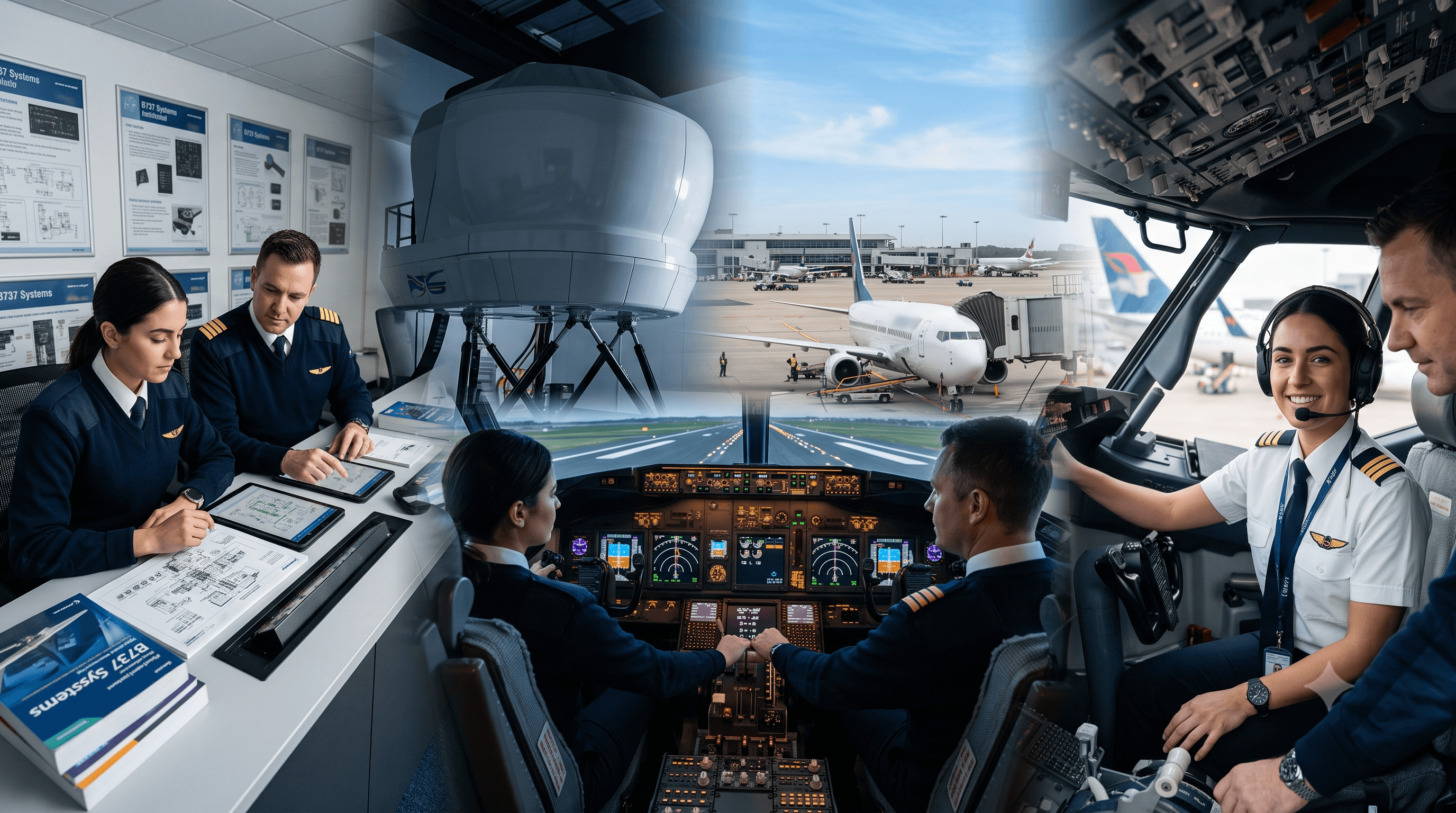
Completing a full-time aircraft type rating takes 4 to 8 weeks on average. The exact duration depends heavily on whether you enroll in an accelerated airline program, your previous flight experience, and simulator availability. While transitioning between variants of the same aircraft family can take as little as 1 to 2 weeks, mastering a complex commercial jet from scratch requires an intensive, multi-phase curriculum. Understanding how this schedule breaks down allows prospective airline pilots to prepare mentally and logistically for the workload.
Phase 1: Distance Learning and Ground School (Weeks 1 to 3)
The journey begins with intensive academic preparation focused on aircraft systems, performance metrics, and operational limitations. Pilots typically complete 2 weeks of home pre-study using computer-based training modules before setting foot in a physical classroom. This self-study phase covers core flight management systems, electrical matrices, and hydraulic configurations.
Once on-site ground school starts, trainees spend 1 to 2 weeks in classroom environments for structured lectures and system reviews. Instructors walk through standard operating procedures, weight and balance calculations, and emergency checklist memory items. Ground school concludes with a comprehensive technical exam, which you must pass before advancing to flight devices.
Phase 2: Fixed-Base and Full-Flight Simulator Training (Weeks 4 to 6)
Simulator training translates theoretical system knowledge into real-time cockpit muscle memory. The first stage uses fixed-base flight training devices to master cockpit flows, instrument setups, and normal checklist procedures. Trainees practice multi-crew coordination, learning how captain and first officer roles divide during standard flights.
Advancing to Level D full-flight simulators introduces full motion and visual immersion. Over 10 to 12 four-hour simulator sessions, pilots practice handling complex system failures, engine cutouts during takeoff, adverse weather landings, and rejected departures. The final simulator day consists of a practical checkride with an authorized examiner to verify operational competency under line-oriented scenarios.
Phase 3: Base Training and Line Integration (Weeks 7 to 8)
The final leg of A320 Type Rating certification bridges simulator success with actual aircraft operations. Base training requires pilots to take an actual airliner into the air to complete a specified number of physical takeoffs and landings without passengers on board. This step cements real-world visual references, landing flare timing, and aircraft handling characteristics.
Following successful base training and license endorsement, pilots enter line training with their employer airline. Flying commercial routes under the supervision of a training captain provides real-world experience in air traffic control communication, fuel management, and live weather decision-making. Line training duration varies based on pilot experience, typically ranging from 25 to 100 flight sectors before final release.
Navigating the Fast-Paced Learning Curve
It takes a lot of concentration, a rigorous schedule, and disciplined self-study to finish a type rating. Pilots who memorize flows, limitations, and callouts before arriving at ground school progress through simulator phases with greater confidence. Treating training like a full-time job ensures you retain complex systems knowledge and meet performance metrics on schedule.
Pacing yourself through the curriculum prevents cognitive overload during high-stress simulator checks. Working effectively with your assigned simulator partner speeds up checklist efficiency and reinforces crew resource management skills. Preparing thoroughly for every phase guarantees a smooth transition from ground training into the airline cockpit.
Wrapping-Up!
Earning a type rating is a rigorous but predictable process that transforms licensed commercial pilots into qualified jet operators. Investing time in pre-study, staying focused through simulator scenarios, and mastering crew coordination leads to quick certification. Structuring your training plan carefully guarantees you meet every milestone and launch your airline career on schedule.
About the Author